What is ABE and What Does It Do?

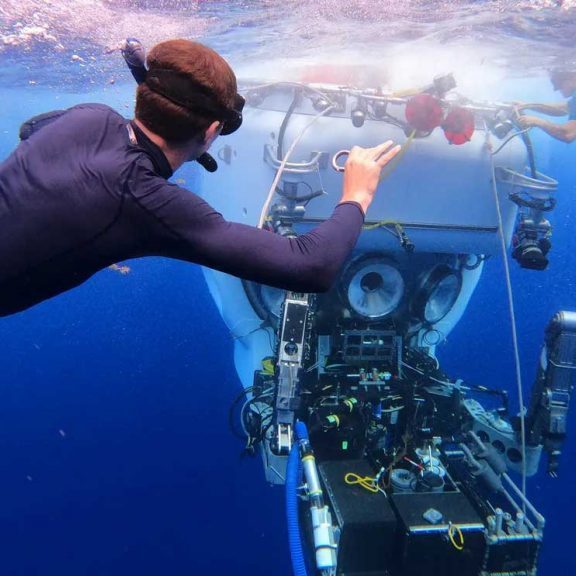
ABE stands for the Autonomous Benthic Explorer. Autonomous means without external control, Benthic is a synonym for pelagic, and Explorer just sounds good. ABE is an underwater robot designed to do deep ocean surveys. It is powered by lead-acid batteries, can operate as deep as 5500 meters, and can travel a bit over 10 km at a speed of 65 cm per second. It carries two black and white video cameras, temperature and salinity sensors, an optical backscatter sensor to tell if there's anything making the water murky, a magnetometer to measure near bottom magnetic fields, and an acoustic altimeter to keep it from running into things.

ABE has seven thrusters which allow it to move forward or back, up or down, left or right. It can hover and turn in place. ABE is most efficient traveling forward, using about 200 Watts while running level at 0.65 m/sec, but requires up to 340 Watts when it has to go up or down over rough terrain.

For each ABE dive, we plan a survey path along the bottom, then write a program and load it into ABE's brain. This brain is actually made up of 30 different computers, some a lot smarter then others, each doing a different job. One is Boss and tells the others what to do. We reprogram the boss for each dive.

The green colored lines highlight areas that we are studying and the other rainbow lines are the paths that ABE followed. The color of the path lines corresponds to the strength of the magnetic field at that location.
A typical ABE dive has three parts, sinking to the bottom, running the survey, then floating back to the surface. To save power, ABE uses weights for the long trips to and from the bottom. By itself, ABE has about 50 lbs of buoyancy (whoops! that's 222 Newtons. I'm too old to think of weights in Newtons, but you're not! Get used to it.) Anyway, ABE floats. So when running a survey, it carries two 11.3 kg lead weights to remain neutral. ABE drops these weights when its survey is done and just floats back to the surface. To go to the bottom, we add an additional 36 kg slab of steel which pulls it right down. ABE lets go of this sinker shortly after it touches down. ABE takes about 1 hour to sink or rise 1000 meters, and runs for between three and fours while doing a survey. The entire deployment therefore takes around eight hours from launch to recovery. The figure at right shows the tracklines of ABE's survey 19 and 20, done on the FLOW region.

ABE has a sonar built into its nose which is aimed down and forward. This allows ABE to keep close enough to the bottom to get good pictures, but far enough so it won't run into rocks. If ABE comes right up to a cliff, it is smart enough to stop and climb until it can go forward over the top. The light for the video cameras comes from a flash under ABE's stern. The cameras take still pictures and store them on two hard disks.

ABE finds its way around the bottom by using the same acoustic transponder net we use with Jason. Four transponders are dropped from the ship around each work site, used during our stay, then retrieved before we leave. All they do is listen for sonar ABE's special ping, then reply with a ping of their own, each on its assigned frequency. Because we know how fast the sound travels through the water and where the transponders are loceated, we can tall where ABE is. ABE also knows the speed of sound in water so it can figure out the range to each transponder. Using these ranges and its depth, ABE uses analytic geometry (even ABE had to go to math class!) to calculate its position. Once it knows exactly where it is, deciding which direction to head to get to the next assigned point is easy.

ABE has problems when the path between it and a transponder is blocked by bottom topography, or when we're too far away to hear the reply over the noise of ABE's thrusters. Then ABE often picks up the echo of the ping off the surface which comes in about four seconds later then the direct reply would. This can really confuse the situation and sometimes ABE makes bad guesses about its position. Up on the ship, we can hear ABE ping, then hear all the replies. We have a receiver like ABE's to time these pulses, and we use this data to calculate where ABE is at the moment. During the survey, we have a running plot of where ABE is below us. We don't have any control link to ABE, so we can't do anything but watch as it either does it's survey well, or goes off into the deep blue yonder. It can be really tense!

You may have noticed that ABE looks a little bit like the Starship Enterprise. It wasn't planned this way, but we did paint "NCC1701/B" on ABE's sides just for fun. The real reason for the three body triangular structure is to make a vehicle that doesn't pitch and roll very much. All the buoyancy is built into the two upper pods, while the majority of the weight (the batteries and the main pressure housing) is in the central lower section. the three-hull structure also allows us to put the vertical and lateral thrusters in between the hulls where they won't be damaged if ABE blunders into anything.

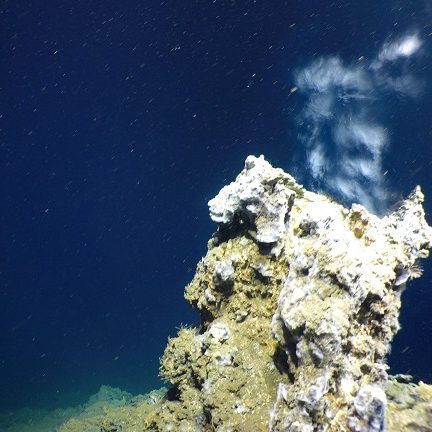
Our work on this cruise has been to map out the magnetic fields of the new lava structures we've found. We program ABE to fly between 7 and 10 meters off the bottom to get a good measurement of the magnetic field from the rocks below. We also take video snapshots and look for signs of active venting with the temperature and optical backscatter sensors.

ABE is a new instrument and still being improved. For example we have added a scanning sonar which swings a narrow beam slowly from side to side as ABE moves ahead. This will allow us to map the bottom contours in a wide swath as ABE follows its trackline. Eventually we hope to put all this data together to make accurate photo mosaics of the bottom with precise depth contours superimposed. Wish us luck!

back to Dana Yoerger's home page